TAMURA Solder Paste
TLF286-171AT
Tamura Solder Paste
Low Void Rate Solder Paste
Due to the increasing miniaturization and high integration of electronic products, the performance requirements for materials in SMT soldering processes are becoming higher and higher. Traditional solder pastes can hardly meet the increasingly complex circuit board designs and more stringent working environments. Especially in the face of requirements such as solder joint reliability, fine-pitch printing, and environmental protection, many electronics factories are looking for more suitable and better-matched solder pastes. Then there is Tamura solder paste TLF286-171AT, which is a type of solder paste with low void rate and high reliability. It is a solder paste developed by Tamura to cope with high-integration electronic soldering. Next, I will elaborate on how Tamura solder paste TLF286-171AT, with its unique technological innovations, has become a practical tool for high-quality SMT soldering!
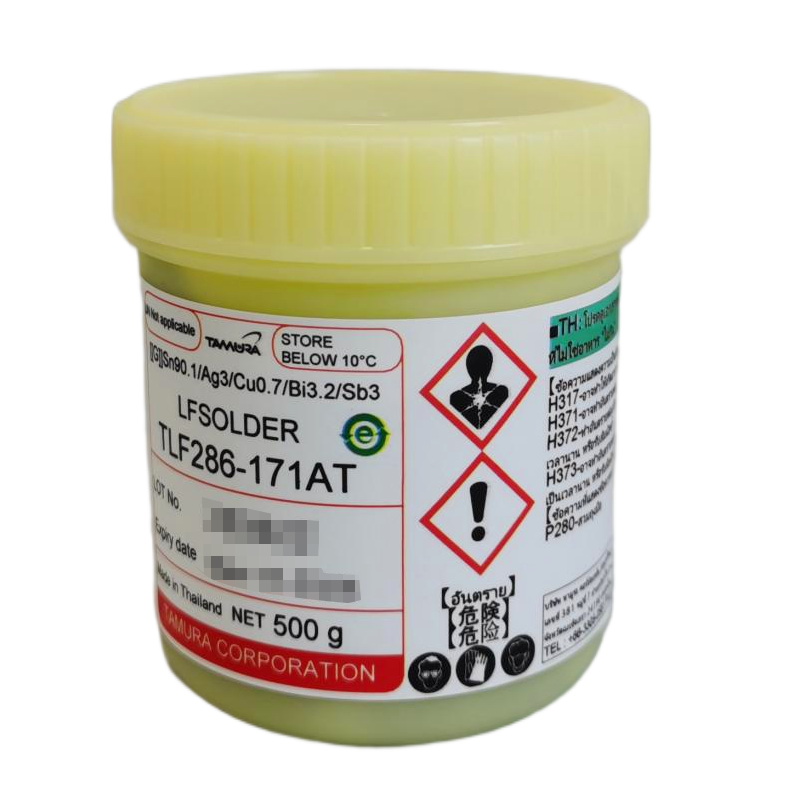
I. TLF286-171AT Solder Paste: Advanced Formulation and Technical Accumulation
Successful SMT soldering is inseparable from the profound technical accumulation of solder paste. The reason why Tamura's TLF286-171AT solder paste can stand out among many products lies in its precisely formulated alloy composition, optimized flux system, and strictly controlled powder technology.
1. Unique Flux Activity: Enhancing Wetting and Reducing Defects
In the parameters of this TLF286-171AT solder paste, the most commendable is its efficient yet mild flux system. During the reflow soldering process, the flux can quickly remove oxides from the pads and component leads, ensuring sufficient wetting between the solder and the metal surface, thereby forming uniform and full solder joints. From my work experience, our team has found that this excellent wettability not only effectively reduces the occurrence of voids but also significantly lowers the risks of cold soldering and false soldering, which is crucial for precision electronic products pursuing zero defects.
2. Precise Powder Particle Size and Rheology: Ensuring Fine Printing
TLF286-171AT uses standard Type 3 (25-45μm) solder powder, which has high sphericity and a uniform particle size distribution, ensuring excellent release performance during the printing process. What's more, its sophisticated rheological properties, namely the thixotropy of the solder paste, cannot be ignored. This means that it can flow under the pressure of the scraper, accurately filling the stencil openings, and quickly restoring viscosity after the pressure is released, maintaining the clarity and fullness of the printed patterns. This characteristic enables TLF286-171AT to easily meet the printing requirements of complex components such as QFN and BGA with a pitch of 0.4mm or even smaller, which is a concentrated embodiment of the advantages of Tamura's HF series solder pastes.
II. TLF286-171AT Solder Paste: Surpassing Tradition, Defining High Reliability
The wide range of applications of Tamura's lead-free solder paste stems from its ability to maintain excellent performance even in harsh environments. TLF286-171AT is not just a substitute that complies with environmental regulations but also a key to improving the long-term reliability of products.
1. Solder Joint Toughness and Fatigue Resistance in Extreme Environments
In fields such as automotive electronics and aerospace, components often face drastic temperature changes and mechanical shocks. The solder joints formed by TLF286-171AT can still maintain excellent mechanical strength and toughness after undergoing rigorous thermal cycle tests (for example, -40°C to 125°C, with more than 2000 cycles), effectively resisting solder joint cracking caused by thermal fatigue. Based on our years of practical experience, the drop resistance of its solder joints is also significantly better than that of ordinary lead-free solder pastes, which is crucial for portable devices and products working in vibrating environments, making it a typical representative of high-reliability solder pastes for SMT welding.
2. Wide Process Window and Excellent Printing Life
Many of our customers have reported that TLF286-171AT has a very wide process window, which means it has good tolerance for fluctuations in the reflow oven temperature curve, reducing the difficulty of process debugging and the requirements for equipment stability. What's more worth mentioning is its excellent printing life, which can maintain stable printing performance on the stencil for more than 8 hours, reducing the number of frequent shutdowns to clean the stencil due to the degradation of solder paste performance, and significantly improving production efficiency and yield.
III. Precautions and Process Optimization for Using TLF286-171AT Solder Paste
No matter how good the material is, it requires careful use and management. To give full play to the performance of Tamura's TLF286-171AT solder paste, here are some key process optimizations and precautions, aiming to provide practical guidance for SMT process engineers.
1. Optimizing Printing Parameters: Ensuring Perfect Solder Paste Transfer
When using TLF286-171AT, in addition to the conventional scraper speed and pressure settings, we strongly recommend paying attention to the stencil design. For fine-pitch components, electro-polished or nano-coated stencils can be considered, and the opening shape can be optimized to ensure perfect release and transfer efficiency of the solder paste. It is recommended to keep the scraper angle between 45-60 degrees, which will help the solder paste to roll and fill better.
2. Fine Tuning of Reflow Profile: Activating the Best Performance of Solder Paste
Although TLF286-171AT has a wide process window, fine tuning of the oven temperature curve can still maximize its performance. The preheating zone should ensure sufficient activation of the flux, but avoid excessive rapid heating which may cause insufficient volatilization of solvents; the peak temperature in the reflow zone is 235-245°C, and the TAL time of 40-70 seconds is the golden rule. The cooling zone should ensure an appropriate cooling rate (2-4°C/s) to form a fine grain structure, further enhancing the solder joint strength.